The cosmetic entry
GHK-Cu skin studies
My interest settles on a cosmetic result with its exact outcome still attached. The procollagen comparison is a useful place to try that.
Procollagen synthesis
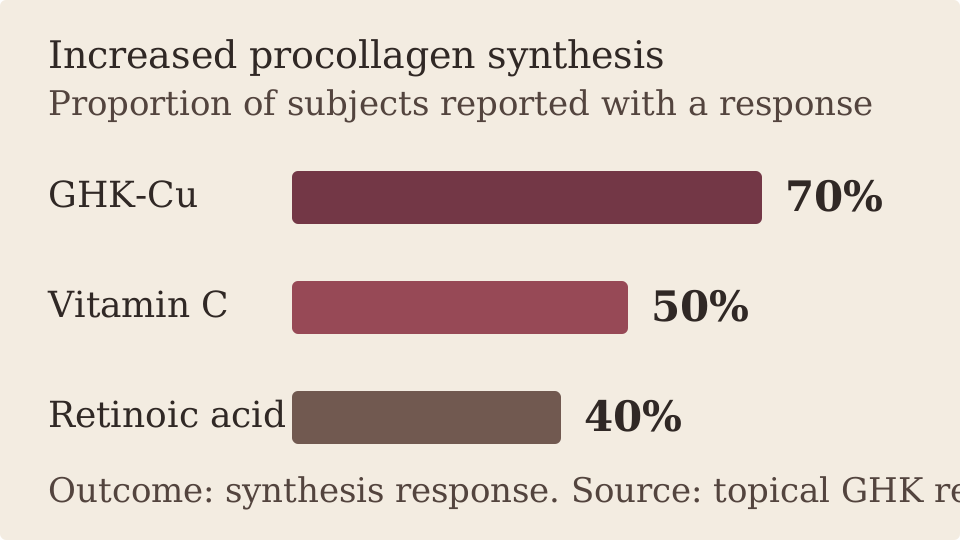
The 2025 review of topically applied GHK reports increased procollagen synthesis in 70% of GHK-Cu-treated subjects, compared with 50% for vitamin C and 40% for retinoic acid. That is an arresting comparison. It is also a comparison with a particular outcome: the proportion of subjects with increased synthesis.
My first temptation is to treat those percentages as a ranking of cosmetic results. On reflection, the percentages earn a narrower job. They describe how often that synthesis response was reported. They cannot, by themselves, tell me the amount of wrinkle change in each person or how much that change mattered to that person.
The 2015 skin-regeneration review reports the same collagen comparison. Seeing it in another review does help trace the finding. I would still count the underlying comparison once when weighing it.
Firmness and wrinkle depth
There are cosmetic outcomes in the record as well. The 2015 review describes placebo-controlled improvements in skin laxity, clarity, fine lines, wrinkle depth and density. Those outcomes get closer to the appeal of a cosmetic preparation.
I take the reported improvements seriously enough to be interested in the preparation. The idea that every cream carrying the ingredient’s name will excel leaves me unconvinced. The later topical review makes delivery a central problem and considers palmitoylation and microneedle pretreatment among the strategies. The preparation can change even while the broad ingredient story stays familiar.
That makes the two findings sit together quite naturally: a topical formulation can produce a reported cosmetic response, and passage through skin can remain a difficult formulation problem. I prefer the preparation beside its outcome, with enough detail to distinguish it from the next cream.
A synthesis percentage tempts me toward a visible improvement. The reported endpoint is a useful brake on my enthusiasm.
Questions about treated skin
A procollagen comparison cannot answer every question about a topical preparation. For skin that has undergone a procedure, a study of that specific situation would be my starting point, including adverse events and the outcome the procedure was intended to change. That is a separate demand I place on a safety argument.
Nothing in these percentages gives me grounds to select a treatment, a concentration or an application schedule for another person. The question I can pursue here is how a preparation was studied. The skin-penetration experiment makes one of its less visible variables easier to examine.